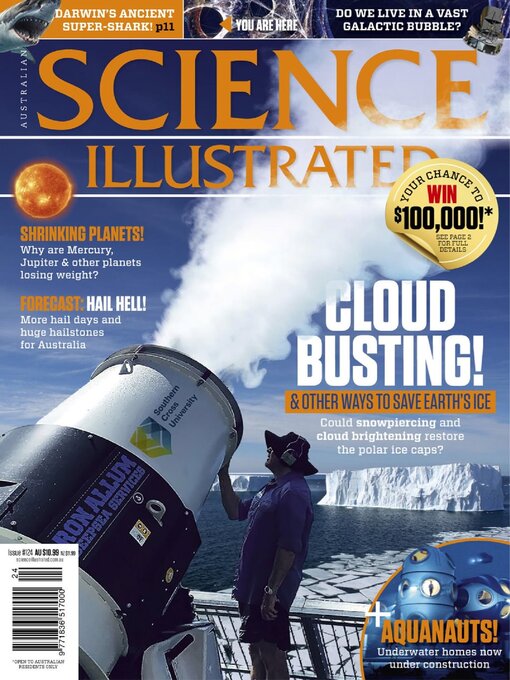
 Issue 124
 Issue 123
 Issue 122
 Issue 121
 Issue 120
 Issue 119
 Issue 118
 Issue 117
 Issue 116
 Issue 115
 Issue 114
 Issue 113
 Issue 112
 Issue 111
 Issue 110
 Issue 109
 Issue 108
 Issue 107
 Issue 106
 Issue 105
 Issue 104
 Issue 103
 Issue 102
 Issue 101
Science Illustrated delivers natural science, break through discoveries and an understanding of the world for the entire family. Packed with stunning photography and in-depth editorial it’s a visually spectacular gateway to the world looking into the beginning of life to distant objects in the universe.
SUBSCRIBE FOR YOUR CHANCE TO WIN $100,000! • What would you do with the ultimate cash prize?
Science Illustrated
MEGAPIXELS
SCIENCE UPDATE • THE LATEST FINDINGS AND DISCOVERIES
How were bog bodies preserved? • Researchers have learned a lot about the diets, customs, and rituals of our ancestors by studying bog bodies. But how can they be so well-preserved after thousands of years?
Why are rocket launches often cancelled in cloudy weather? • “Satellite launches often seemed to be cancelled by weather conditions. But if a rocket has the power to launch itself into orbit, why is it so sensitive to wind and other weather phenomena?”
How do insecticides work? • Both farmers and picnickers use chemicals to get rid of unwanted insects. But some effective insecticides do not break down naturally, harming animals up the food chain.
Does 5G drain my phone battery faster? • “My phone can use 4G or 5G and switches between whatever’s available. It seems that the battery gets used faster when it’s 5G – does 5G really consume more power?”
Why does wound cleaning with alcohol sting?
…our Solar System had two suns? • “What if our solar system had an extra star? How would that affect the planets? And what about life on Earth?”
Binary stars may include life • Binary star systems are divided into three main types, which have different possibilities for planets with life.
What is twilight, and how does it affect your eyesight? • “I have read that there is not only twilight but three stages of twilight. How are these stages defined, and what happens to our eyesight as the light fails? I can tell we lose the ability to see colours, but do our eyes adjust somehow to the dim light?”
Aussie scientists pave the way to smoother rocket exhaust design • Current rocket designs assume that fuel exhaust products emerge as nice uniform spheres. But researchers at Monash University have shown the true situation to be far more complex – and chaotic – than expected.
TEST YOURSELF • Solve problems designed for different types of intelligence, and find out in which you excel!
Why is ice slippery? • “Why do we slip on ice? Which phenomenon is at work? Is it simply very weak friction, or something else?”
Can mammals be cold-blooded?
Fish hooked on ‘reels’ show lower brain growth • Swedish scientists made growing fish watch videos to see what happened. Their brains developed more slowly.
Can human structures be seen from space? • “I’ve heard that being able to see the Great Wall of China from the Moon is a myth – is that correct? Can any human structures be seen from the International Space Station, which is closer?”
Too much video, not enough time
…noise-cancelling headphones are harmful? • Headphones that block external noise are increasingly popular. Could they have unexpected long-term effects?
CAN WE PREVENT EARTH’S ICE FROM MELTING? • While our Hemisphere watches Antarctic glaciers shrinking, sea ice in the Arctic is melting faster than even the most dire forecasts predicted. Researchers are testing possible rescue plans. One professor’s idea has been labelled ‘insane’ – but could it work?
Melted ice poses a threat to marine life • Sea ice forms a barrier between water and atmosphere, and when it melts the cold sea warms and absorbs CO2 from the air. This sets off a chemical domino effect which makes life difficult for the sea’s inhabitants.
Drones to refreeze Arctic using...