
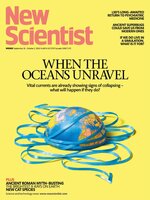
 Sep 26 2026
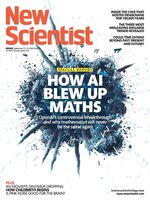 Sep 19 2026
 Sep 12 2026
 Sep 05 2026
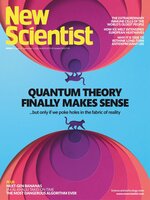 Aug 29 2026
 Aug 22 2026
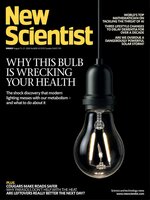 Aug 15 2026
 Aug 08 2026
 Aug 01 2026
 Jul 25 2026
 Jul 18 2026
 Jul 11 2026
 Jul 04 2026
 Jun 27 2026
 Jun 20 2026
 Jun 13 2026
 Jun 06 2026
 May 30 2026
 May 23 2026
 May 16 2026
 May 09 2026
 May 02 2026
 Apr 25 2026
 Apr 18 2026
New Scientist covers the latest developments in science and technology that will impact your world. New Scientist employs and commissions the best writers in their fields from all over the world. Our editorial team provide cutting-edge news, award-winning features and reports, written in concise and clear language that puts discoveries and advances in the context of everyday life today and in the future.
A note from the editor
Alive and kicking • Unexpected hints of dark matter show particle physics is far from dead
Has a dark matter particle been found? • Directly observing dark matter could reveal some of the universe's biggest secrets. The first particle may have been spotted, but it's not an overriding victory just yet, finds Leah Crane
Europe's expanding wildfire threat • Conditions this year have sparked wildfires in countries that are normally considered to be damp and cool. What can we do to mitigate the risk in the future, asks Madeleine Cuff
The scramble for Ukraine war data to feed AI • Foreign states and technology firms want access to drone data so they can train AI models that might be used for national security
AI beats mathematicians – again • Formalising Fermat’s last theorem was expected to take years, but AI has done it in 11 days
Psilocybin may stop nerve damage • The psychedelic compound could prevent a common side effect of chemotherapy that can disrupt treatment, potentially improving cancer outcomes, finds Carissa Wong
Can we really reverse global warming after passing 1.5°C? • A UN report says we could cool the planet back down to current temperatures in the future, but many researchers regard this as highly unlikely
Laughter therapy may help people with a common form of lung disease
Warning over mountain warming • There will be more disasters like the Nepal flood as mountainous regions around the globe warm rapidly, melting the ice that glues rocky slopes together, discovers Michael Le Page
Bizarre weather pattern seen on Saturn
Deepest-ever nuclear reactor • A nuclear reactor will be installed further underground than ever before, setting the stage for a radically different way to build small nuclear plants, finds Vanessa Bates Ramirez
Groundbreaking neutrino laser may be impossible to build
Lithium's new frontier • Should we all be taking low doses of lithium to prevent Alzheimer's? As a human trial is about to start, Alice Klein looks into the benefits and downsides of the metal
Against the clock • Is time dilation real? Einstein thought so, but he also thought it is an apparent phenomenon related to our perception. Karmela Padavic-Callaghan looks at why he was right both times
A micro-safari • In The World Beneath Our Feet: The hidden life of soil and why it matters to us all, photographer and soil ecologist Frank Ashwood urges us to better appreciate and protect the soil we rely on. He does so with stunning images of the creatures that call soil home.
Hunting the real Vikings • The stories we tell about the Vikings often say more about us than them. A fascinating book tries to show the Norse as they were
How to boldly go... • As Star Trek celebrates its 60th birthday, how can newcomers bond with its sprawling universe? Bethan Ackerley seeks help from three of New Scientist’s crew
Views Your letters
Inside the vacuum • Quantum theory says a vacuum isn't truly empty. Probing it with powerful lasers could finally expose its hidden structure
The great escape • As golden oyster mushrooms are declared a high-risk invasive species in the UK, mycologist Joni Wildman looks at whether hobbyist home-grow kits are seeding a biodiversity crisis
We can't explain everything we've seen in the universe with just the...